
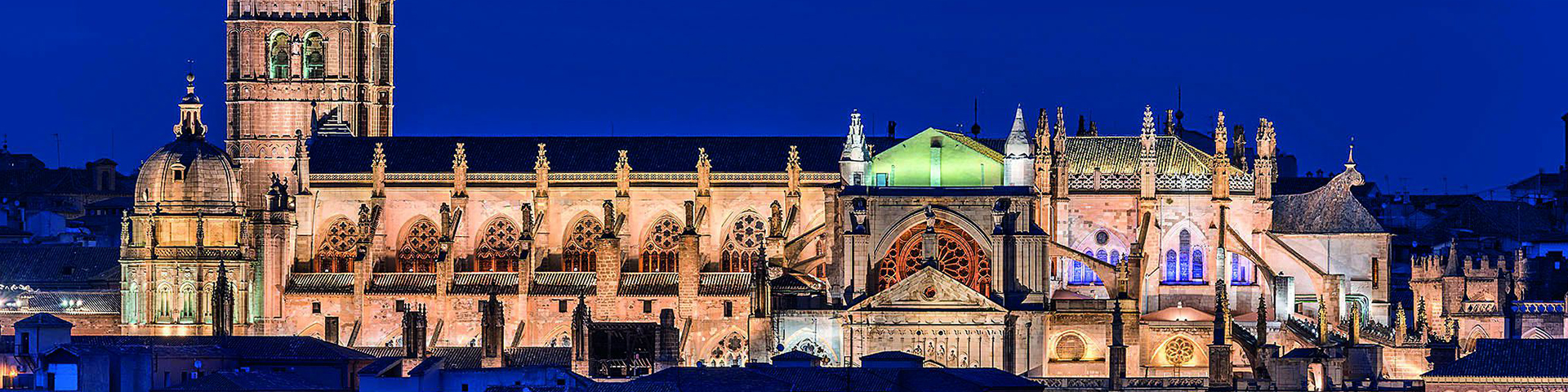
Religious tourism: Toledo Cathedral celebrates eight centuries
Toledo looks once again to its Primatial Cathedral with a commemoration set to hold a prominent place in the city’s cultural and spiritual life. The Eighth Centenary of the temple is proposed not merely as a historical anniversary but as an invitation to journey through eight centuries of art, faith, music, and architecture. Within this framework, the Jubilee Year will be a key moment in a program that seeks to attract both pilgrims and travelers interested in the heritage and living history of one of the great symbols of the Spanish Gothic style. Set in the heart of the old town, Toledo Cathedral is one of the main icons of the Spanish Gothic style and a space capable of condensing much of the city’s spiritual and artistic history in stone, light, and silence. Its construction, begun in 1226, led to a monumental temple with a Latin cross floor plan, five naves, 72 vaults, and 88 columns, considered over several centuries to be a religious seat, an urban symbol, and an exceptional repository of heritage. The Eighth Centenary celebration is not intended to be a single event, but a collective narrative unfolding across major areas. The voice, memory, stone body, cultural dimension, and spiritual life of the Cathedral allow visitors a better understanding of the scope of a celebration where faith, art, music, and heritage create an experience open to different audiences. This comprehensive perspective reinforces Toledo’s role as a destination for cultural and religious tourism, linked to knowledge, sustainability, and a respect for heritage. One of the major milestones is the Primate: Eighth Centenary of Toledo Cathedral exhibition, which can be visited until October 14, 2026 inside the temple itself. The exhibition traces the history, art, and spirituality of the primatial seat from the 13th to the 18th centuries, with more than 350 works and pieces linked to names such as El Greco, Velázquez, Zurbarán, Alonso Cano, Giovanni Bellini and Luca Giordano. This project also includes significant restoration work that will remain as a legacy beyond the commemoration.

Music will be another essential language of the Centenary celebrations. Organ Battles, repertoires related to Cardinal Cisneros, choral proposals, musical cycles, and a Musicology Symposium dedicated to the Cathedral's archive will project a sound tradition linked for centuries to liturgy, the organ, and singing. The Jubilee Year will begin on October 25, coinciding with the Dedication of the Primate Temple festival. The opening of the Holy Door, also known as the King's Door, will solemnly mark the beginning of a time of grace and pardon granted by the Holy See to those who undertake a pilgrimage to Toledo. Over the course of twelve months, the Cathedral will host celebrations and jubilees dedicated to families, artists, musicians, priests, brotherhoods, journalists, Marian associations, the sick, grandparents, and other realities of Christian life.
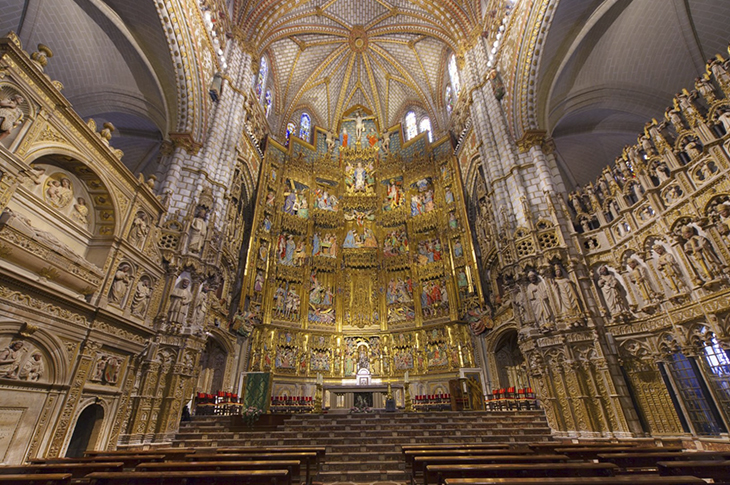
Beyond its liturgical dimension, the Jubilee invites visitors to cross the threshold of beauty as a path toward the spiritual. To receive the indulgence, the pilgrimage must be directed to the Holy Primate Cathedral Church of Toledo and be connected to prayer, confession, participation in Mass, and Eucharistic Communion. This inner journey turns the visit into an experience of renewal, contemplation, and encounter. With the closure scheduled for October 2027, the Cathedral will not be closing a chapter but will be projecting a new cycle of life. Eight centuries later, Toledo offers a celebration capable of attracting travelers interested in culture, faith, art, and heritage with rigor, substance, and depth.
Location
Toledo is located in the center of Spain, in Castile-La Mancha, about 70 kilometers from Madrid. Its main access points are the A–42 and the AP–41 from Madrid. It has an Avant rail station connecting to Madrid–Atocha–Almudena Grandes. The nearest airport is Adolfo Suárez Madrid-Barajas.