
Religious route through the Region of Murcia: convents, springs and processions
Jubilee cities, unique monasteries and popular celebrations reflect centuries of spirituality
The Region of Murcia preserves a religious heritage that slowly reveals itself among its mediaeval fortresses, sanctuaries surrounded by nature and cities where devotion is part of everyday life. With Caravaca de la Cruz as the great reference point of pilgrimage, this territory unites experiences linked to saints, relics and centuries-old traditions. Its churches, museums and popular celebrations allow an intimate approach to a history in which spirituality coexists alongside art, culture and local customs.
The spiritual heart of the Region
Legend ascribes one of the episodes that shaped the identity of Caravaca de la Cruz to the year 1232. As the myth goes, two angels descended from heaven with a lignum crucis so that the priest Ginés Pérez de Chirinos could celebrate mass before King Abu Zayd. This story remains linked to the Castle, a fortress of Arab origin that houses the Santuario de la Vera Cruz, whose construction began in 1617 and which is renowned for its monumental red marble façade from Cehegín. Caravaca has the privilege of celebrating the Jubilee Year in perpetuum every seven years, an honour it shares with Rome, Jerusalem, Santiago de Compostela and Santo Toribio de Liébana. Its spiritual heritage also preserves the footprint of Saint Teresa of Jesus, who founded a convent here in 1576, and of Saint John of the Cross, who visited the town several times and founded the Convent of Our Lady of Mount Carmen in 1587.
Relics and sanctuaries amidst natural landscapes
In Mula, the religious heritage is part of a historic quarter declared a National Artistic Ensemble in 1981, where the narrow streets preserve churches and convent buildings of great value. The Royal Monastery of the Incarnation houses the Reliquary of the Holy Thorn, and the Hermitage of Carmen is home to relics of Saint Teresa of Jesus and Saint John of the Cross. This town embraces its Holy Week with fervour, especially during the Night of the Drums, one of its most deeply rooted popular demonstrations. Calasparra stands our for the Sanctuary of Our Lady of Hope, located by the Segura River, in the area of Las Lomas de la Virgen, where spirituality coexists harmoniously with an environment of notable beauty. Its interior houses the images known as La Grande (The Big One) and La Pequeñica (The Tiny One), while the museum preserves mantles, jewellery and other pieces related to Marian devotion. The municipality is also known for its caves with prehistoric paintings, declared a UNESCO World Heritage Site.

Sacred art and special celebrations
The city of Murcia possesses a prized religious heritage, with its cathedral being one of its greatest exponents. The temple combines Gothic, Renaissance and Baroque elements, with an imposing façade designed as a large altarpiece. The Salzillo Museum offers insight into the work of the famous image maker from Murcia, whose sculptures take centre stage during Holy Week, where processional art coexists with deeply rooted popular customs. Lorca transforms its streets and squares during the Biblical Passionate Parades, renowned for their embroidery, chariots, horses and the historical rivalry between the Paso Blanco and Paso Azul brotherhoods. Its embroidery museums display the pieces used in these celebrations throughout the year. Cartagena, in turn, features processions characterized by solemnity, order and a strong military tradition.
Popular devotion in natural surroundings
In Totana, the Sanctuary of Santa Eulalia de Mérida is located in the surroundings of Sierra Espuña, amidst pine forests and native vegetation. Its Mudéjar coffered ceiling, crafted in 1595, and the 17th-century mural paintings enrich the heritage value of this religious site, where architecture and nature share the limelight.
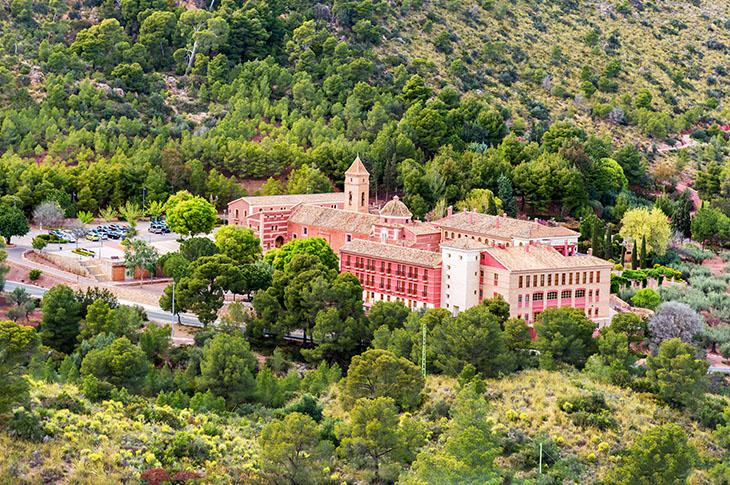
Abanilla upholds one of its most representative traditions every 3rd of May, when the Pilgrimage of the Holy Cross gathers numerous faithful around the Hermitage of Mahoya. This celebration reflects the deep-rooted devotion that maintains a close connection with popular customs, in a town where the arid landscape contrasts against the fertile lands watered by the Chícamo River.
Location
The Region of Murcia is located in the southeast of Spain, along the Mediterranean Sea. It borders Andalusia, Castile-La Mancha and the Region of Valencia. Its main access points are the Región de Murcia International Airport, the port of Cartagena and the Murcia del Carmen and Cartagena train stations, with medium and long-distance services.