
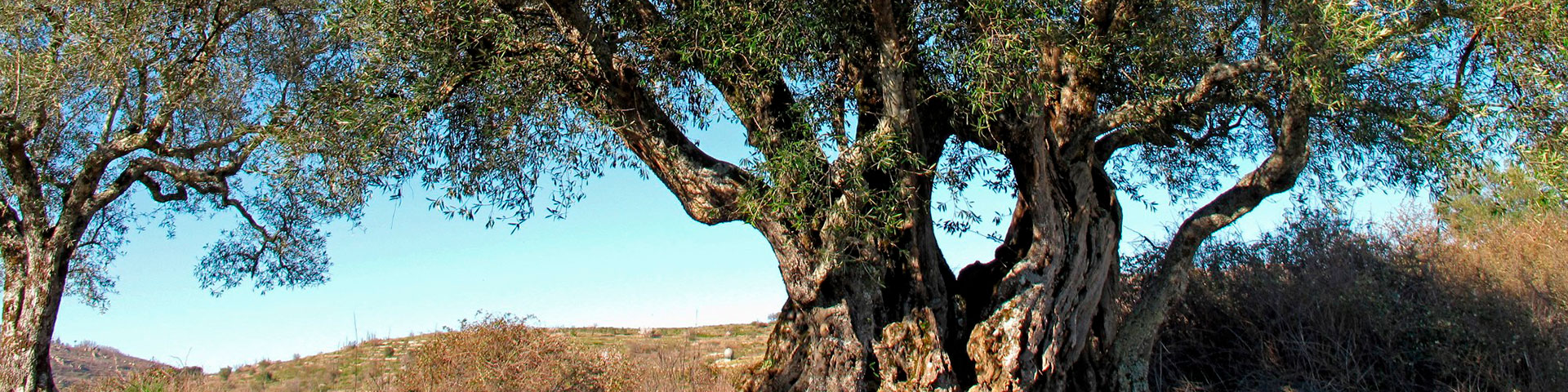
Living Cathedrals: a journey through Salamanca following its monumental trees
A leisurely experience among century-old specimens that connect scenery, memory, and land
Salamanca invites you to explore its land from a different perspective through the Living Cathedrals route, an itinerary that connects towns and landscapes through monumental trees boasting centuries of history. Two routes crisscross riversides, countrysides, and mountain ranges following specimens protected because of their longevity, size, and uniqueness, turning each locality into a spot where nature, local identity, and collective memory blend into a leisurely travel experience. The route provides the opportunity to discover the province by linking rural destinations through a heritage that grows in the outdoors. Each monumental tree acts as a meeting point between the landscape and the town, incorporated into squares, paths, riversides, or natural surroundings that are an essential part of the local identity. The Tormes Trails route passes through towns in the northeastern part of the province, where the river and its surroundings have historically shaped the life of these municipalities. In San Pedro del Valle, the century-old ash tree is located next to a fountain, creating a space of calm and well-being linked to the traditional use of water. In Juzbado, the riverside poplar stands next to an old crossing over the Tormes River, reminding us of its role as a communication route. Meanwhile, Florida de Liébana and Valverdón add to the itinerary trees located on private estates, such as the elm on the Villaselva estate or the sequoias of Hacienda Zorita, easily locatable and closely linked to the agricultural and river landscapes.
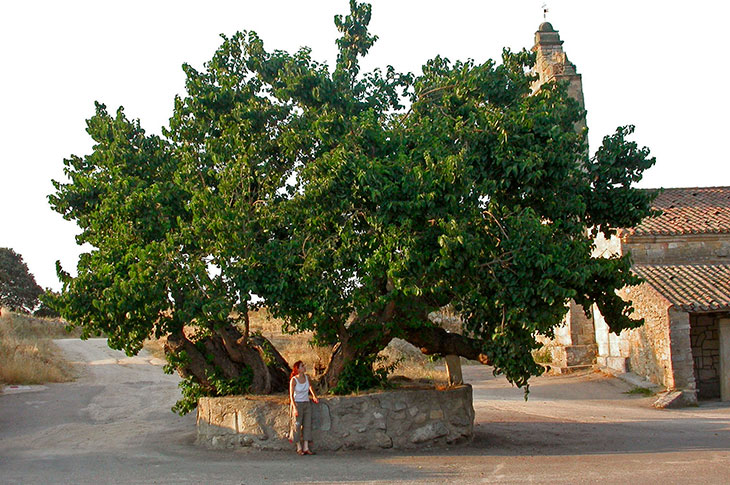
Other towns such as Torresmenudas and San Pelayo de Guareña reinforce the historic nature of this route with their centuries-old mulberry trees, located next to urban spaces that form part of everyday life. The itinerary also ventures into Valdelosa, Zamayón, and Santiz, where the cork oaks create natural settings of great ecological value. In Almenara de Tormes, the arboretum unites various species in a space designed for visitor enjoyment and the future development of the project. In the south of the province, the Sierra de Béjar and Entresierras route connects towns that value nature. Sorihuela opens up the route with its century-old pine, while Béjar offers the setting of the Renaissance Garden of El Bosque, where a large sequoia stands tall. Cantagallo, Montemayor del Río, and El Cerro add cork oaks, cypresses, and oaks to the itinerary, incorporated within urban spaces and cemeteries, thus reinforcing the relationship between nature and community. The route continues through Lagunilla, Endrinal, San Miguel de Valero, San Esteban de la Sierra, Valdefuentes de Sangusín, and Peromingo, where chestnuts, poplars, cork oaks, mulberries, and olive trees complete a journey that crosses mountain villages and inland valleys. A journey that turns each destination into an experience linked to time, territory, and the silent presence of trees that have witnessed generations pass by. Location Salamanca is located in the west of Spain, within the autonomous community of Castile and León, bordering Portugal. It is connected by the A–62 (Burgos–Portugal) and the A–66 (Silver Route) highways. It has an airport at Salamanca–Matacán and a train station with connections to Madrid.