
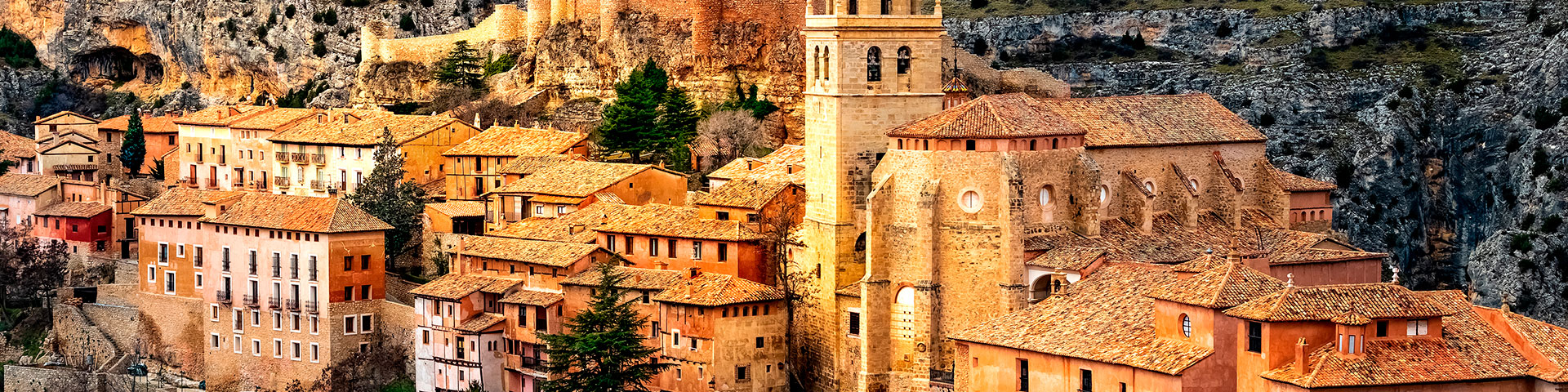
The Enchanting Villages Route: a journey to Spain’s most beautiful essence
A medieval itinerary bringing together nature, heritage, and tradition
The Enchanted Villages Route traces an inspiring itinerary through the emblematic towns of the Most Beautiful Villages of Spain Association, along a trail that unites medieval heritage, landscapes seemingly frozen in time, and an authenticity that attracts visitors in pursuit of unique experiences. From Templar mountains to villages guarded by castles, this route invites you to travel slow, discover local flavors, and let yourself be carried away on a living legacy that can be felt in every stone. The journey begins in Anento (Aragon), a village hidden within a limestone valley where the castle and the Celtiberian tower watch over a meticulously maintained medieval hamlet. Its streets, Romanesque church, and the surroundings of the Aguallueve spring envelop visitors in a feeling of serenity that accompanies them throughout the journey. Nearby, Calaceite awaits, declared a Historic-Artistic Ensemble with an urban layout built from golden stone. Its main square and manor houses offer up the ideal setting for leisurely strolls through streets preserving the legacy of the Matarraña.
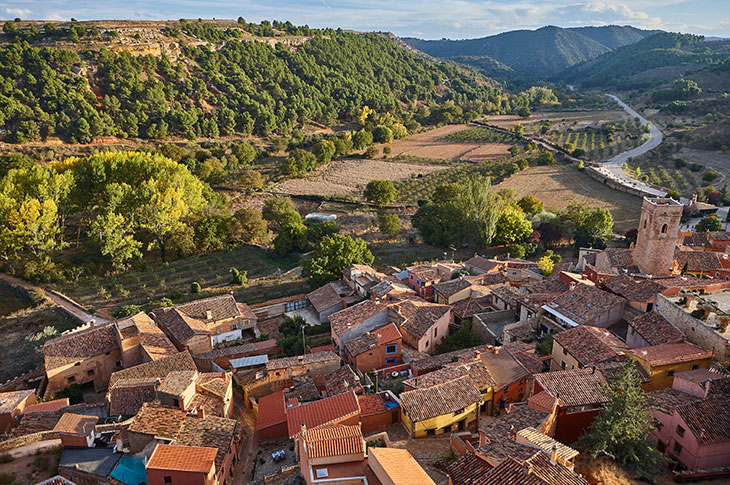
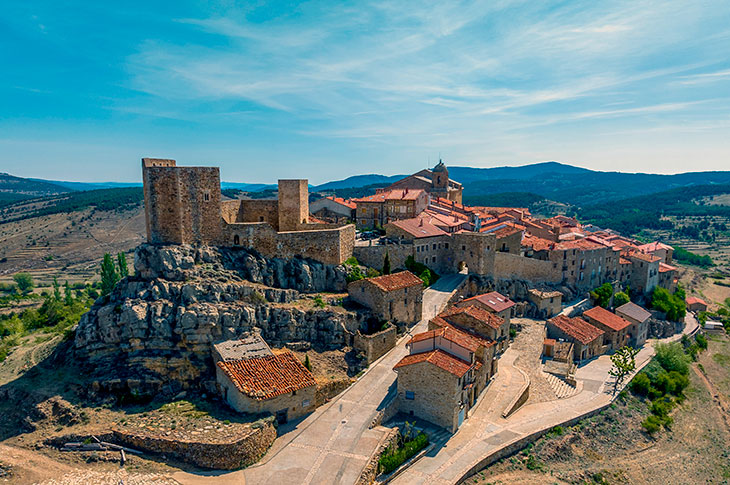
The route advances towards La Fresneda, with its distinct medieval and Renaissance character. Its arcaded squares, traces of the Order of Calatrava, convent, and the views from the castle evoke centuries of history. Next, the landscape leads us toward Valderrobres, where the Gothic bridge and its castle form one of the most iconic images of inland Spain. Its old town, declared a Cultural Interest Site, reflects a noble past that continues to define the town's identity. Further along we find Mirambel, a walled municipality characterized by an almost monastic atmosphere. Its origins linked to military orders and the tranquility of its streets offer a gentle pause for those seeking disconnection. This road then extends to Cantavieja, perched on a limestone crag and marked by a Templar, Hospitaller, and Carlist legacy that has shaped its history. Its square, church, and viewpoints shape a site with a rich memory. In Linares de Mora, traditional architecture blends into a mountainous landscape that invites visitors to explore its walls, historic bridges, and cobbled streets with their preserved medieval character. The route continues in Puertomingalvo, a high mountain destination combining popular architecture, trails, and expansive views of the surroundings. Further south, Rubielos de Mora welcomes travelers as the Gateway to Aragón, a recognized historic ensemble with a collegiate church housing a Gothic altarpiece.
The journey then reaches Albarracín—which, although close to the Region of Valencia, administratively and territorially belongs to Aragon—a medieval icon included in the Network and currently up for UNESCO World Heritage status. Its reddish silhouette and winding streets make up a unique setting. In Valencia itself, the Templar town of Culla (Region of Valencia) emerges, surrounded by rock art and walls that recount centuries upon centuries of history. Up next, we have Vilafamés, with its old town of Arab origin and Roca Grossa rock; and Morella, a walled city topped with a castle that looks down over the landscape. Finally, this route culminates in Peñíscola, a medieval destination by the sea where the Templar castle and its old town offer the experience its symbolic finish.
Location
Aragon is located in the northeast of Spain and can be accessed via the A–2, A–23, and A–68 highways, Zaragoza airport, Zaragoza–Delicias train station (AVE high-speed rail), and various regional rail connections. It does not have any seaports. The Region of Valencia, on the Mediterranean coast, is connected via the A–3, A–7, and AP–7 highways, and is served by the airports of Valencia, Alicante–Elche Miguel Hernández, and Castellón. Its main seaports are located in Valencia, Alicante, and Castellón, while it offers AVE high-speed rail and long-distance connections from the Valencia–Joaquín Sorolla and Alicante stations.