
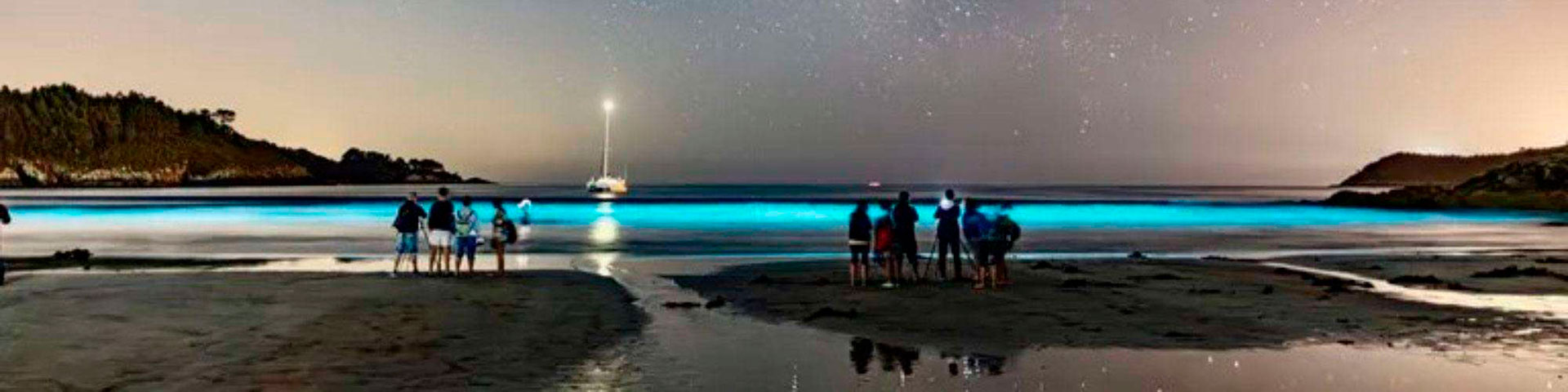
Ardora Sea: the nighttime journey that illuminates Galicia’s wildest coasts
An unpredictable phenomenon that transforms Galician beaches into landscapes of light and silence
On the darkest nights of summer, when the noise fades and the ocean seems motionless, the coast of Galicia offers one of its most hypnotic spectacles: the Ardora Sea. This natural phenomenon, visible mainly between July and September, transforms the water into a mantle of bluish and greenish lights activated by movement. Unpredictable and deeply evocative, it has become one of the most sought-after experiences by travelers pursuing authentic emotions, as well as families wishing to share a natural discovery off the beaten path. It is a mobile phenomenon that can appear along various stretches of coastline, following ocean currents and the concentration of bioluminescent phytoplankton. However, there are places where natural conditions make it more likely and the experience especially intense, facilitating calm, accessible, and safe nocturnal outings, even with children, always under the criteria of caution and respect for the environment. The Costa da Morte is home to some of the most iconic spots to observe this luminous sea. Carnota beach, the longest in the region, offers a unique setting: its vast expanse provide the perfect setting to contemplate wide stretches of illuminated water, where each wave draws lines of light in the darkness. In this open and silent environment, the phenomenon takes on an almost hypnotic dimension. Further north, Muxía and its coastal surroundings join this nocturnal map. The combination of open sea, summer temperatures, and low light pollution favors the appearance of bioluminescence, especially on calm nights. Nearby, beaches such as Os Riás, in Malpica de Bergantiños, stand out for their isolated nature and minimal human presence, allowing the phenomenon to be enjoyed from the shore or even from the cliffs when the tide covers the sand.
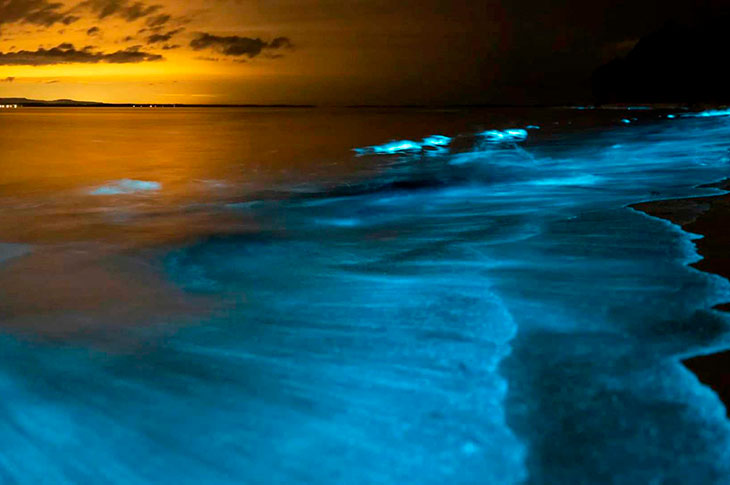
Other notable sites are scattered along the coast of A Coruña. Rebordelo, in Cabana de Bergantiños; A Ermida, in Ponteceso; or the beaches of Estorde and Gures, in the municipality of Cee, have become established as regular spots for those seeking the Ardora Sea. In O Ézaro, where the landscape is already spectacular by day, the night adds an unexpected element when the water starts to glow with every movement. The Cíes and Ons islands also rank among the most evocative places to enjoy the experience, thanks to their shallow waters and complete absence of light pollution. There, this phenomenon is perceived with special clarity, reinforcing the feeling of witnessing an almost untouched natural spectacle. The Ardora Sea cannot be tamed. There are no guarantees or established schedules, only favorable conditions and plenty of patience. Precisely for this reason, those fortunate enough to witness it describe it as a once-in-a-lifetime moment, comparable to gazing at a starry sky over the ocean. In Galicia, the night can be illuminated without any artificial aid, reminding us that some of the most memorable journeys happen when nature decides to reveal itself. Location Galicia is located in the northwest of Spain, bordering the Atlantic Ocean, Portugal, Asturias, and Castile and León. It is connected by the AP–9, A–6, and A–52 highways. It has airports in Santiago de Compostela, A Coruña, and Vigo; ports in A Coruña and Vigo; and a railway network offering AVE services to Madrid.