
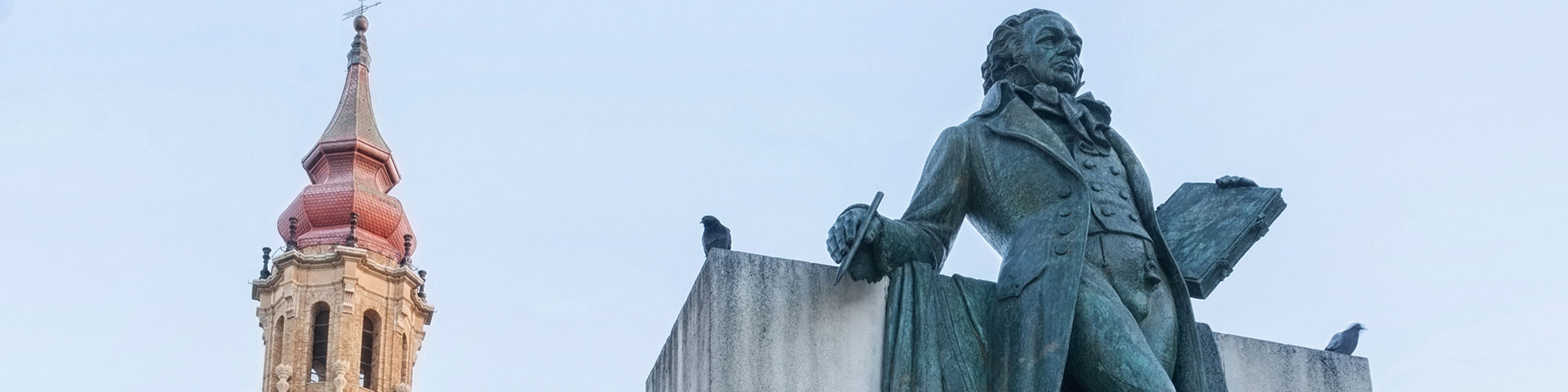
Goya’s land: heritage, art, and landscape on a cultural route through Aragon
Churches, palaces, and museums reveal the painter’s evolution in his native land
Aragon is still home today to some of the key settings necessary to understand the origins and artistic development of Francisco de Goya y Lucientes, born in Fuendetodos in 1746. Churches, museums, monasteries, and towns near Zaragoza shape a cultural itinerary that allows visitors to discover the land in which the painter took his first creative steps. From his birthplace to his religious frescoes or the great collections of engravings, this itinerary reveals the close relationship between the artist and his homeland. The route starts in Fuendetodos, a town located about 30 miles from Zaragoza, where the artist was born. There, art lovers can visit Goya's Birthplace, a modest farmhouse arranged over three floors and furnished with 18th-century furniture and objects. Every year it attracts thousands of visitors eager to learn about the environment in which the painter spent his early years. A few meters away, you’ll find the Goya Museum of Engraving, inaugurated in 1989 and housed in a restored Aragonese house. This center brings together four series of engravings by the artist: Los Caprichos, The Disasters of War, Tauromaquia and Los Disparates. Open 365 days a year, the entrance fee (€3) also includes a visit to his birthplace and other museum spaces. On the same street, lies the Sala Zuloaga, dedicated to temporary exhibitions of contemporary graphic art.

The city of Zaragoza is home to a number of other essential venues to understand the painter’s career. In the El Pilar Basilica, the artistic completed two fundamental works: The Adoration of the Name of God, on the cupola of the Coreto opposite the Virgen del Pilar Chapel, and Regina Martyrum, which gives its name to the dome on the north side of the temple, in which he depicted the Virgin surrounded by angels and Aragonese martyrs. The artist's legacy continues in the city's museums. The Museum of Zaragoza preserves important portraits from his time as a court painter, including those of Charles IV, María Luisa of Parma, and Ferdinand VII, in addition to graphic works and religious paintings. The Goya Museum. Ibercaja Collection, located in the Palacio de los Pardo, exhibits fourteen paintings, one drawing, and the five major series that Goya engraved between 1778 and 1825. This museum is open daily, with a general admission price of €8, a 50% discount for minors and persons with disabilities, and €6 for groups of 10 to 25 people, without guided tour. On the outskirts of Zaragoza, lies the Aula Dei Charterhouse, where a young Goya painted eleven scenes dedicated to the life of the Virgin Mary, of which seven large-format murals are still preserved today in the monastery church. The route can also be expanded through various surrounding municipalities. In Muel, the Virgen de la Fuente Hermitage preserves the pendentives painted in 1772 with the four Fathers of the Church. In Remolinos, the San Juan Bautista Church houses four oval paintings on the same theme, while it was in Calatayud, in the San Juan el Real Church, that the artist represented this iconography for the first time. A number of other locations round off the itinerary. In Alagón, The Exaltation of the Name of Jesus—a fresco attributed to Goya—decorates the cupola of the Casa de Cultura, a former Jesuit school that now also houses the Museum of Contemporary Hispanic-Mexican Art. In Pedrola, the Palace of the Duchess of Villahermosa, a 16th-century Renaissance building, preserves three works linked to the artist: The Masked Ball, a sketch of The Charge of the Mamelukes, and a half-length portrait of Ramón Pignatelli. This tour through Aragon offers a detailed understanding of the artistic geography in which the career of one of the most influential creators of European art began.
Location
Aragon is located in the northeast of Spain, bordering France to the north and Catalonia, the Region of Valencia, Castile-La Mancha, Castile and León, La Rioja, and Navarre. Its main access points are via Zaragoza Airport, the railway network with connections to Madrid and Barcelona, and the A–2, AP–68, and A–23 highways.